

Restoring a California Creek Enhances Salmonid Habitat in Redwood Forests

In Northern California’s coastal forests, massive redwoods tower over their surroundings. Crossing between these behemoths are countless streams that snake through the forest, emptying into larger rivers and eventually the Pacific Ocean. These waterways are crucial for salmon, which traverse upstream to their historic spawning grounds.
However, human pressures have long hindered these upstream migrations. Large dams on major rivers are usually the culprit and receive significant attention when they’re removed, celebrated for releasing sediment buildup and providing upstream access.
But sometimes salmon must travel far into the watershed, reaching smaller streams in the heart of forests. Such is the case of Cooper Mill Creek in California, a small but important salmon spawning creek that was impeded by human infrastructure for decades.
However, a recent fish passage and habitat improvement project has changed Cooper Mill. These projects aren’t guaranteed success, so after the project is finished, scientists are monitoring the stream to ensure it will remain suitable for these keystone species.
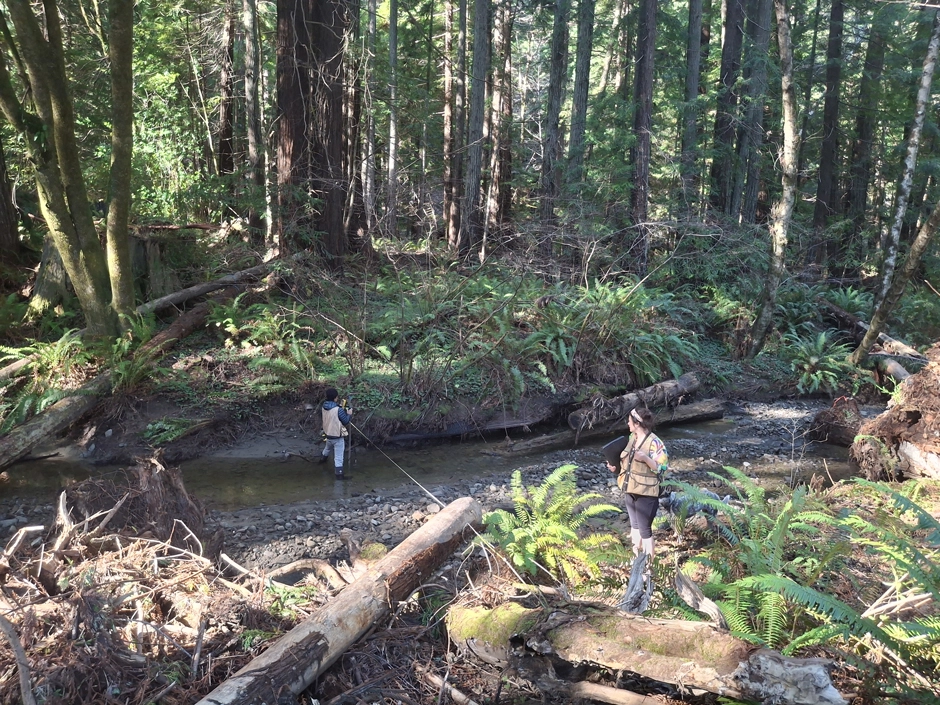
PWA Hydrologists measure discharge in Cooper Mill Creek as part of this ecosystem restoration project. (Credit: PWA)
Improving Fish Passage and Habitat on Cooper Mill Creek
The project was funded through the California Department of Fish and Wildlife’s Fisheries Restoration Grant Program. The program was launched in 1981 in response to declining salmon and trout populations in the state, and it aims to “reestablish natural ecosystem functions.”
The Cooper Mill Creek fish passage and habitat improvement project began in 2019. The first action on Cooper Mill was to remove barriers on the small creek, according to Hector Flores, a Staff Geologist and Hydrologic Technician at Pacific Watershed Associates, Inc. (PWA). PWA partnered with Trout Unlimited and conducted the project on Humboldt Redwood Company property.
“Removal of the fish barrier will allow for upstream salmonid spawning grounds to become available,” Flores says.
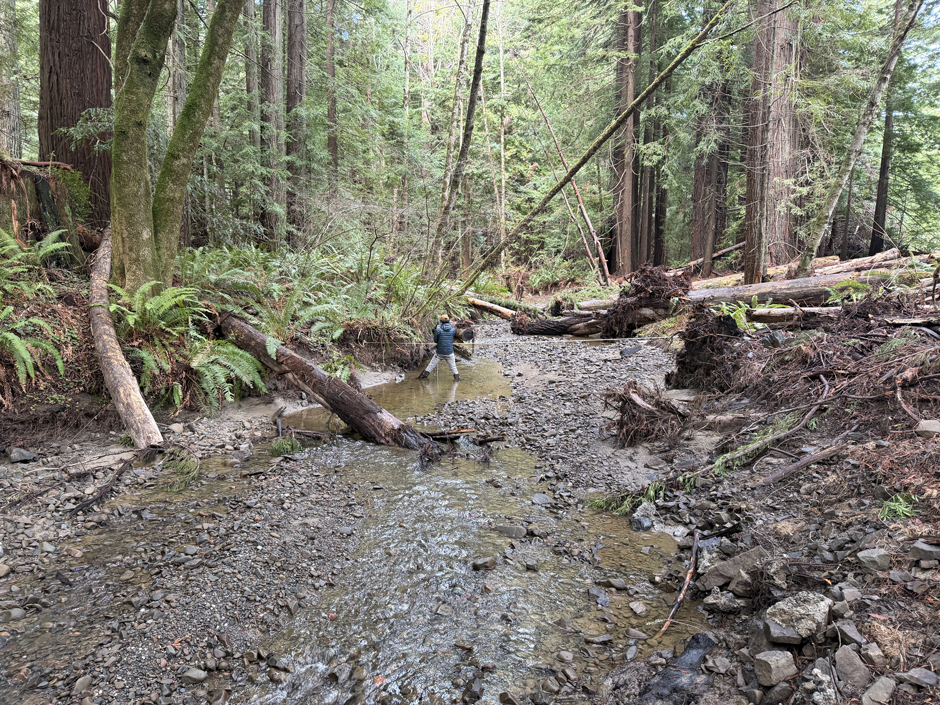
PWA Hydrologists work in the Coastal Redwoods to enhance salmonid habitat by placing large wood in strategic locations. (Credit: PWA)
The barriers on Cooper Mill included a concrete sill and a boulder weir near the creek’s headwaters. Flores says the project also constructed several alcoves in the middle section of the creek. These more stagnant side pools offer refuge for fish during high and low flow events.
Moreover, large redwood trees and rootwads were added to the creek banks upstream and downstream of the removed barriers. Flores says these structures will improve sediment deposition and reduce erosion, increase the creek’s sinuosity, and create gravel deposits for salmon spawning, as well as provide habitat complexity and cover from predation.
The Cooper Mill Creek project aims to help salmon at all life cycle stages by creating spawning grounds for fry and improving habitat for adults. Flores says the partners also widened and modified the most downstream section of Cooper Mill to improve fish passage throughout the entire system.
“A channel realignment of the confluence between Cooper Mill and mainstem Yager Creek [will] allow for passage of salmonids at all life stages,” he says.
The California Department of Fish and Wildlife, NOAA, Trout Unlimited, and Humboldt Redwood Company have monitored salmon populations in the Cooper Mill and Yager Creek watershed in the past. PWA will soon monitor for salmonids in the project area now that the project is finished.
The restoration of Cooper Mill Creek was completed in 2025. Now, Flores says he and other PWA scientists are responsible for monitoring the creek for the next three years.
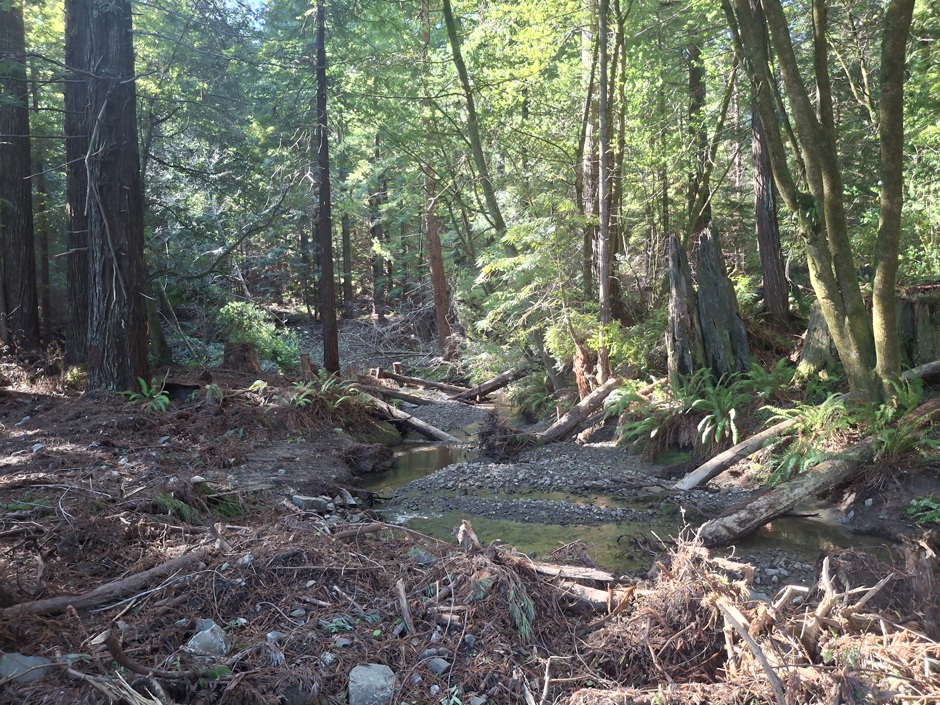
Placing large wood in streams has many benefits for aquatic ecosystems. These include altering flow patterns and storing gravel that is essential for spawning salmonids. (Credit: PWA)
Monitoring Hydraulic and Geomorphic Creek Changes
Along with improving fish passage and spawning grounds, removing barriers on the Cooper Mill Creek will change the creek’s flow patterns. According to Flores, removing the weir upstream and widening the creek at its confluence should slow its velocity, especially during intense precipitation events.
To understand these potential changes, PWA conducts stream monitoring pre- and post-restoration. Flores says they primarily measure stream discharge.
“We do this to collect base-level data along representative channel cross sections, to construct hydrographs, and to refine our stream discharge models when engineering is involved,” he says of the pre-restoration monitoring.
The team’s post-restoration work includes water quality monitoring and more stream discharge monitoring. They monitor stream flow directly after intense precipitation events, as a goal of the project was to lower the creek’s velocity after heavy rains. The PWA scientists use a SonTek FlowTracker2 to measure these currents.
“We aim to measure discharge on the falling limb, after peak flow,” says Todd Kraemer, a Senior Hydrologist at PWA.
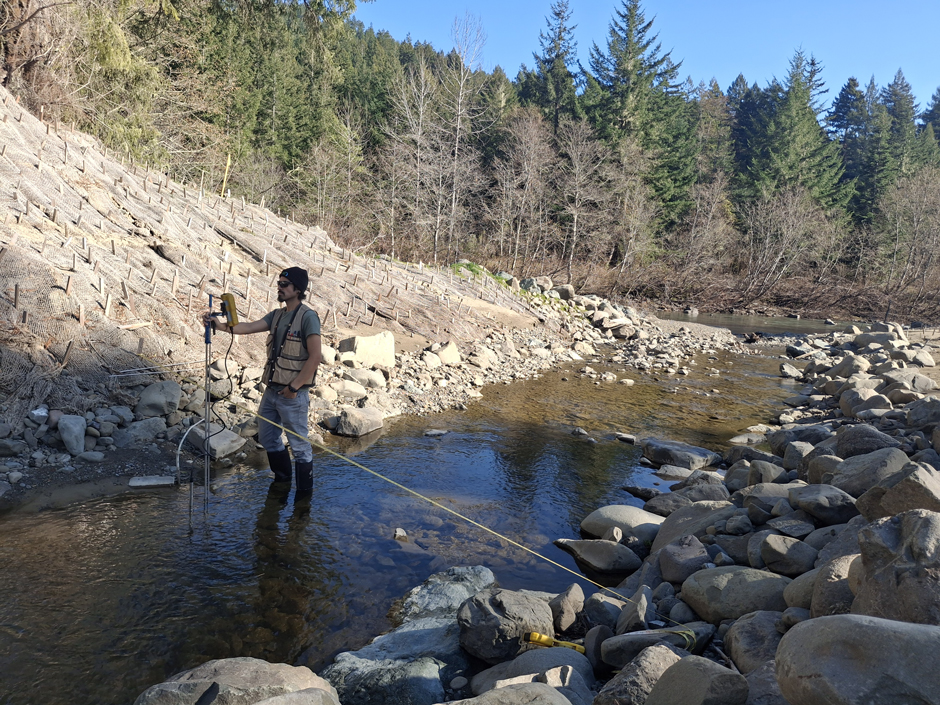
Performance monitoring in low-flow conditions is a requirement for monitoring. PWA Hydrologists use discharge measurements and biological monitoring to inform agencies.
Understanding how the stream responds just after peak precipitation is an important method to measure the project’s success. Furthermore, understanding stream discharge before and after precipitation events shows which restoration practices are working.
“By graphically viewing the differences, if any, in the rising and falling limbs of the hydrograph, we can better understand how wood, sediment storage, and increasing the channel’s capacity to slow flow by spreading out are impacting the geomorphic changes and habitat quality for salmonids,” Flores says.
If the discharge is acceptable, it’s also a good sign for salmon. With safe stream flow and unimpeded passage upstream, salmon will find Cooper Mill Creek more inviting than in the recent past.
While discharge and water quality data are being collected, Flores says he’s seen some instant geomorphic changes in Cooper Mill Creek. Sediment is being rerouted and stored behind their wooden structures, which is decreasing turbidity. Moreover, he’s seeing less bank erosion, which likely points to positive discharge results.
The salmon are likely benefiting as well. Flores says that a perennial flow during drought conditions has provided a continuous corridor for aquatic species, a positive for the project. Similarly, peak flow monitoring has indicated that geomorphic changes have increased backwatering and access to upstream habitat for winter rearing.
Overall, the project has improved the habitat and capacity for salmon to thrive in Cooper Mill Creek’s upstream reaches, and the creek itself has increased hydrogeomorphic complexity and is winding more freely through the redwoods once again.
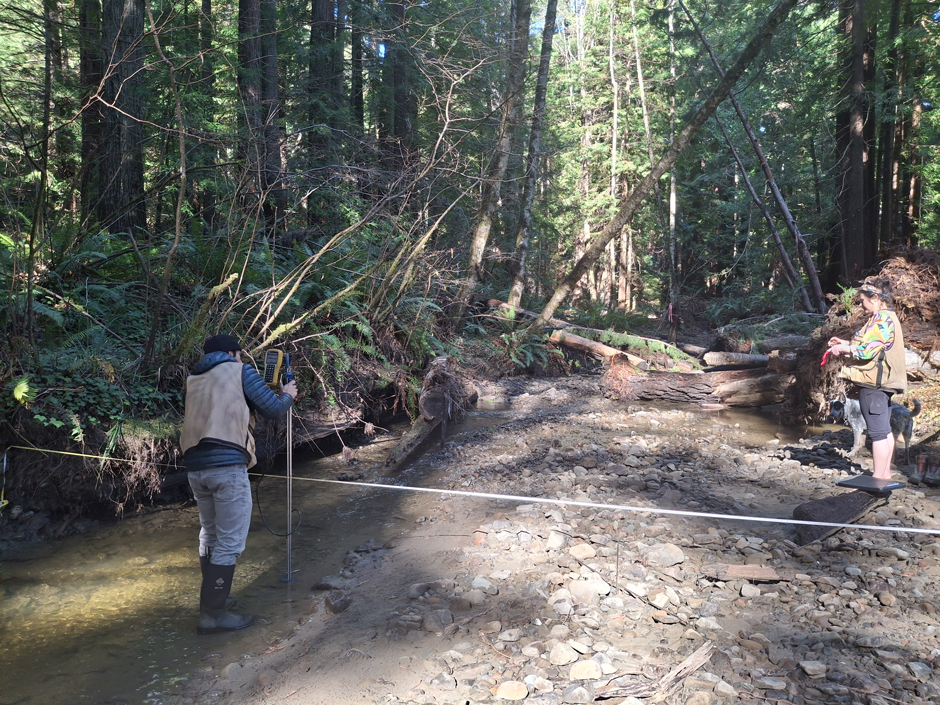
Discharge measurements by PWA Hydrologists inform adaptive management decision-making. (Credit: PWA)




0 comments